More Anti-Amazon reporting, this time from Austria

I’m a regular viewer of the Austrian TV program Kulturmontag (Cultural Monday), though I watch the 3sat repeat entitled lebensart (Way of Life), probably because the repeat is broadcast on a Saturday rather than Monday.

But whatever the title, Kulturmontag/lebensart is a mix of reports about cultural topics. And the latest edition included a report about Amazon. The occasion is the publication of the German edition of The Everything Store by Brad Stone, but the report is the by now all too familiar anti-Amazon diatribe that Passive Guy tends to subsume under the heading “Amazon derangement syndrome”.

BTW, I wanted to link to the video of the report, but unfortunately the ORF Mediathek blocks it and the 3sat Mediathek doesn’t even have it. So here is a summary from the Kulturmontag website instead. BTW, the link to the German edition of the Brad Stone book goes to the publisher’s website and not to Amazon, so at least they’re consequent.

There are the familiar complaints about bad working conditions, we get a few soundbites from the Brad Stone book, there are complaints that Amazon is killing off local bookstores due to underpricing (which won’t work, because most European countries including Germany and Austria, have a fixed book price law), there is a shout-out to German writer Sibylle Lewitscharoff who wrote an essay entitled “Why I hate Amazon” (though she spends most of the essay talking about books she loves, before she talks about hating Amazon for the usual reasons) and a few soundbites by German non-fiction writer and undercover journalist Günter Wallraff, who also hates Amazon and the Kindle and fears that Amazon is tracking his reading habits on behalf of the NSA. Both Günter Wallraff’s and Sibylle Lewitscharoff’s books are available at Amazon BTW, though Günter Wallraff does not have an Author Central page.

In short, it’s anti-Amazon rhetoric as usual, laced with a dose of xenophobia, since for some reason none of the German or Austrian Amazon haters ever complain about the traditional mail order retailers whose working conditions weren’t/aren’t exactly stellar either. Nor do the low wages and bad working conditions in certain supermarket chains get a lot of press, even though employees there earn less than Amazon warehouse employees. But those are German companies. Amazon is not.

Now I’m not an uncritical Amazon fangirl at all. I do continue to patronise local brick and mortar bookstores in addition to Amazon and I have an account at German Amazon competitor Thalia.de as well. However, what people like Sibylle Lewitscharoff or Günter Wallraff or the authors of that Kulturmontag/lebensart report forget is that as someone who primarily reads English language genre fiction and not just the biggest bestsellers either, I was never very well served by the wonderfully varied German and Austrian bookselling landscape (scroll down to the comments for other German readers of English language fiction reporting their experiences).

Neither am I “lazy” for ordering at Amazon (a frequent charge in reports such as this one), it’s simply the only way for me to get the books I want to read. Before Amazon came to town, English language books had to be special-ordered at the store, took weeks to months to arrive and were horribly overpriced due to distributors inflating the prices. A standard US mass market paperback now costs me as much as it did when I started buying them in the late 1980s, even though the US-dollar cover prices have almost doubled in the same period. Part of this is due to exchange rate fluctuations, but the biggest reason is that the price hike due to the distributors. Prices for English language mass market paperbacks in German brick and mortar stores have come down by now, but the selection is still very limited. And Thalia.de isn’t really an alternative – at least not for English language books – as this comparison shows.

Send to Kindle
Posted in Bookselling | Tagged , , , , , , | 2 Comments

Indies take all top ten spots at Amazon Germany

The German blog Self-Publisher-Bibel (title says it all, really) reports that on January 29, 2014 all top ten spots in the German Kindle store were taken by indie books and has a screenshot to prove it. The first trad pub book – by Joyo Moyes who is inexplicably popular in Germany – only shows up at No. 11.

Digital Book World also has an English language post about this phenomenon and The Passive Voice offers some discussion in the comments.

Send to Kindle
Posted in Bookselling, Links | Tagged , , , , | Leave a comment

Indie Speculative Fiction of the Month: January 2014

Indie Speculative Fiction of the Month

Welcome to “Indie Speculative Fiction of the Month”, a new feature on this blog.

So what is “Indie Speculative Fiction of the Month”? It’s a round-up of speculative fiction by indie authors newly published this month, though for the debut edition some December books snuck in as well. The books are arranged in alphabetical order by author. So far, all the links only go to Amazon.com, though I may add other retailer for future editions.

We have a broad spectrum of books, ranging from modern fairy tales via historical fantasy, epic fantasy, paranormal romance, urban fantasy, dystopian SF and space opera all the way to hard science fiction. There are books for all age ranges, from a collection of bedtime stories for young children to some very dark and adult works. I know all of the authors at least vaguely and have read other works by several of them. However, I haven’t read the books themselves, so Caveat emptor.

And now on to the books: Continue reading

Send to Kindle
Posted in Indie Speculative Fiction of the Month | Tagged , , , , , , , , , , | 1 Comment

Why and how to write novellas

In the past, I blogged about how the rise of e-publishing has also given the longer forms of short fiction, namely the novelette and the novella, a new lease on life after traditional print publishing had largely eliminated them.

But though novellas have become newly viable, a lot of people seem confused with regard to what a novella is and how to write one, which is only to be expected, considering that the novella has been marginalized for so long.

So here are two primers on the novella form and how to write it:

At The Kill Zone, James Scott Bell offers his advice for writing a novella focussed on the crime and suspense genres. It’s a nice concise primer, though I don’t agree with everything he says. For while my one genuine novella Mercy Mission only has a single POV character, the even shorter Silencer novelettes usually have several POVs and the Zane Smith/Shoushan Kariyan novelettes have duelling first person narrators.

At One Thousand and One Parsecs, Joe Vasicek tackles the novella form from the perspective of an SF writer. Now science fiction is the one genre (along with fantasy) where the novella never really died out. The most commonly used distinction between the various lengths and forms of fiction was laid down by the SFWA and the big genre awards like the Hugos and Nebulas award both novellas and novelettes.

I agree with Joe’s point that the novella and novelette forms offer more room for complexity than a short story, but don’t get as sprawling and over complex as many novels. However, I’d add another advantage and that is that novellas and novelettes are ideal for ongoing series featuring the same characters.

All of my three series, the Silencer series of 1930s set pulp thrillers, the Zane Smith/Shoushan Kariyan series of 1960s set spy adventures (I really need to find a snappier title for those) and the Shattered Empire series of space opera adventures are all comprised of novellas or novelettes. My upcoming romantic suspense series New York City’s Finest (the first installment is currently going through copyediting and proofing) will be of a similar format.

All three, soon to be four, series are made up of self-contained stories featuring the same setting and cast of characters. The Shattered Empire series as well as the upcoming New York City’s Finest series have an overarching plot, namely the Galactic Rebellion in the case of Shattered Empire and the hunt for a gangster boss known only as The Kraken in New York City’s Finest. The Silencer and Zane Smith/Shoushan Kariyan series don’t have an overarching plot – the individual novelettes are self-contained, though there may be references to previous adventures.

As for why I write this way, rather than the currently popular serial format, I guess it’s due to having read so much SF in my formative years. Because a lot of the great epic SF works are basically assembled more or less self-contained novellas and novelettes due to the fact that they were published in magazine form first. Sometimes, this is acknowledged, e.g. with Isaac Asimov’s Foundation trilogy, which is really a series of seven novellas and novelettes, or parts of Lois McMaster Bujold’s Vorkosigan series or – for an indie example – Hugh Howey’s Wool. Sometimes it’s not acknowledged, e.g. I strongly suspect that Simon R. Green’s Deathstalker saga was at least partly assembled from novellas or novelettes, because the whole saga has a choppy and episodic feel, jumping from planet to planet, character to character and adventure to adventure (the planet of the homocidal killer toys segment near killed me, because it fits in with very little around it).

Indeed, I’d argue that the format of a series of more or less closely interlinked novellas is ideal both for the crime and suspense genres (to which three of my series belong) as well as the space opera genre, to which the remaining series belongs. Because the standard format for the crime genre – the format that was established by Edgar Allan Poe himself and continues to this day both in literature and TV – is that of “same investigator(s), different cases”. The cases themselves are usually fairly self-contained and not overly complex with a defined beginning and ending.

In science fiction, particularly the space opera subgenre, the situation is exactly the opposite. Because space opera is a truly epic subgenre. It spans planets and galaxies, has a cast of dozens, if not thousands and can span many decades or even centuries. Cramming all the different plot threads, adventures, characters and planets into a single big book or trilogy is a daunting task. However, focussing just on a few characters in a single setting (or two) with a single problem is a lot easier, both for the reader and the writer. And so space opera is the ideal genre for novellas.

Shattered Empire is very much built up this way and indeed the premise specifically states that the series tells the story of the great galactic rebellion against the Fifth Human Empire from the POV of its protagonists. Hence, Mercy Mission focusses on Ethan and Holly (more Holly, since Ethan doesn’t like being the POV character) and a specific rebel mission. Debts to Pay, the next installment, will focus on Holly’s friend Carlotta Valdez and a different mission. And there’ll be more stories featuring Ethan, Holly, Carlotta, rebel leader Arthur Madden and other characters who haven’t even shown up yet. So far, I’m trying to keep myself from jumping around in time as well, which is difficult, because I have an almost complete Holly and Ethan adventure set some time after Mercy Mission, which simply isn’t due yet, because the relationship has developed considerably in the meantime.

If I tried to tell the whole Shattered Empire saga in a single go, it would likely be a massive mess. Now I have some of those massive messes buried on my harddrive and trust me, you don’t want to see them. Neither do I, until I can actually find a way to organize them into something at least vaguely readable. But a series of interlinked novellas is doable. Even better, if a reader doesn’t care about a specific character, they can skip any installments featuring that character.

Send to Kindle
Posted in Books, Writing | Tagged , , , , , , , , , | 1 Comment

Interview with Science Fiction Writer Edward M. Grant

Today I welcome science fiction author Edward M. Grant to my blog. Edward has been kind enough to answer a few questions for me.
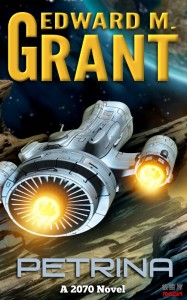
Petrina by Edward M. Grant1. Tell us a bit about yourself.

I grew up in Britain and studied Physics at Oxford, but emigrated to Canada some years ago. By day, I work in satellite communications, which keeps me very busy, but I’ve been self-publishing my writing for a couple of years now as time permits.

2. For how long have you been writing and why did you start?

As long as I remember. While clearing out my old bedroom in my parents’ house when I emigrated, I found a book of stories I wrote when I was nine, some of which were quite entertaining despite their many flaws. As a boy, I was more likely to be found in a library than playing football, so progressing to writing stories like the ones I enjoyed reading came
naturally.

I joined a fairly serious hard SF writers’ group in the 90s, and many of the other members went on to at least moderate success, but sending a paper manuscript of a short story across the Atlantic and waiting a couple of months to find out whether the magazine had accepted it (nope) grew old fast. Then I didn’t write many stories for ten years or so, until Amazon and Smashwords made self-publishing easy, and magazines began accepting submissions over the Internet.

In fact, I’ve now self-published revised versions of about half the stories I wrote for that group.
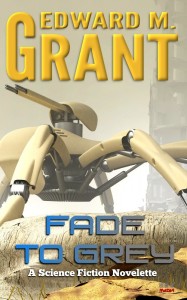
Fade to Grey by Edward M. Grant3. Tell us a bit about your books.

I primarily write science fiction, though I dabble in horror. I’ve mostly been writing shorter stories (4-15,000 words), but, the more I write, the longer the stories seem to become.

Probably my favourite so far is ‘Fade To Grey’, a 15,000 word novelette. For years, I’ve been wondering why we can’t see any aliens in the galaxy, and, in this story, it’s because alien luddites destroyed all life on their planet. Their ancient planetary defence system then destroys a passing human ship, and a maintenance bot, the ship’s synthetic intelligence computer, and the last surviving passenger try to bring the planet back to life.

One of the Amazon reviews suggested I should rewrite it as a novel. I’ll have to think about that, as I’m sure there’s enough left untold in the story to make it work.
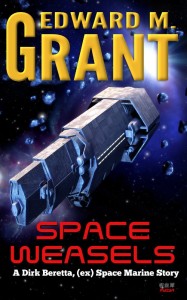
Spaceweasels by Edward M. Grant4. You write two series, the Dirk Beretta series and the Area 52 series. So who is Dirk Beretta and what is Area 52?

Dirk Beretta was the poster boy for the Space Marines, but quit after the battle of Din Bin Foo, where many of his friends were killed by Space Weasels, who then cooked and ate them with a nice Merlot. In the current series, he’s in a love/hate relationship with the rich girlfriend he rescued from a fate worse than marinating in the Space Weasels’ kitchens, and keeps running into trouble while he looks for another job that suits his destructive skills.

It’s either a parody of or homage to the kind of pulpy science fiction I used to read as a kid, and I’m still not quite sure which. I invented him for a writing example on a web forum and never intended to do anything more, but he wanted me to write a complete story about him. Then more ideas kept coming, so I’ve released three stories and I’ve written most of the fourth, which has time-travelled into ancient Egyptian steam-punk. It’s currently a novella, but may end up as a novel.

In Area 52, a young man who reports to the British Army for his National Service in the 1950s finds himself working as a guard for a base outside a tiny Yorkshire village. Except, unknown to him, hidden beneath the Nissen huts is a cut-price version of America’s semi-mythical Area 51, where the British government keeps all the strange creatures and objects they’ve found around the Empire over the last few centuries.

Having finished the second story on something of a cliff-hanger, I was going to write the third, but decided I should really combine them into a novel. Hopefully I’ll finish that this year, and release it to close that initial story arc.

There are also my 2070 stories, which are more of a shared world than a series. They’re more serious, set in the next few centuries (hence the name), and attempt to make the science and technology as realistic as possible. The human race is expanding across the solar system, Earth is a wasteland after WWIII, the Battle of Armageddon may or may not have happened, there’s little government left, and most societies fear outsiders because one person with a grudge can destroy an entire town or space habitat.

5. Most of your published works are short fiction. Now as a short fiction writer myself, I believe that the e-books are ideal for stand-alone short stories which would never be viable in print form. But at least in my experience, short stories also sell much worse than novels. So what do you think the future holds for short fiction in e-book form?

Oddly enough, I seem to be one of the few people who’ve found their short stories sell better than novels, though I suspect that’s largely due to low sales of my one published novel.

One of the best things about self-publishing is that stories can be the length they need to be, without having to pad or cut to keep a publisher happy. I grew up reading many 40-60,000 word novels, but they’ve almost disappeared from book store shelves because publishers think all readers want longer ones. With the fast pace of modern life, I’d often rather buy a shorter story I can finish in the time I have available, than a novel I’d have to read over several days or weeks. So I think short fiction has a much brighter future now than it did in trade publishing.

6. Worldbuilding is crucial for science fiction. So how did you approach the worldbuilding for your books?

For different projects, I’ve tried the ‘plan everything in advance’ method, the ‘make it up as I go along’ method, and a number of stages in between. Planning allows you to make the world consistent, but runs the risk that you spend all the time creating the world, and not enough thinking about the stories to tell in it (or writing them). Making it up is faster, but risks building a world that makes no sense.

I made up the Dirk Beretta world as I went along, but the more I write, the more throwaway background details I can expand on in future stories. Because it’s pure space opera, I can get away with a lot.

Some of Area 52 was inspired by war stories I heard as a kid from men who had been in the forces in WWII, or during the National Service era when almost everyone had to serve for two years. Most of them either seemed to have been fighting for their lives, or, like Ron at the beginning of the story, bored to death with little of any value to do. I also read a lot of wacky UFO and conspiracy books as a kid, and thought how much more fun the world would be if the Bermuda Triangle really was a vortex to another universe, Area 51 had aliens in the freezer, and the Moon was hollow and full of UFOs. So it was more a matter of deciding what wouldn’t go in than what would, and doing my best to research the military of the time to make it as accurate as I can; I still need to work more on that.

The 2070 stories are approaching hard SF, so that’s more complex and requires more research; the basic premise came from a role-playing game I developed at school, and, while that’s massively mutated over the years, I now have a couple of megabytes of notes about the history, the people and the places. I spent much of the time working through the consequences of some of the changes that seem likely to occur in the next few decades, such as dramatic genetic modification and life extension, 3D printing eliminating many jobs, and the economics of a space-faring culture with technology only a few decades ahead of us. I find a lot of SF worlds make no sense if you think about the economics for long, and I’m trying to avoid that problem.

7. Unlike many science fiction writers (interviewer raises hand), you studied physics and are actually a scientist. How does your physics background influence your SF?

It’s very useful for the 2070 stories, because they are harder SF. When, say, I need to work out how large the Big Momma space freighter has to be to carry enough fuel to travel between two asteroids in two weeks, or how fast it would accelerate, I can sit down and go through the numbers. It’s less useful for the space opera stories, because I keep thinking
that the things I’m writing could never actually happen!

8. Have you ever been traditionally published or did you ever pursue traditional publishing? And if so, what were your experiences?

I wrote some non-fiction articles for a science and technology magazine in the 90s, but that’s the only time I’ve seen my name on a book store shelf. I still submit some of my stories to magazines like Asimov’s and Analog, but I’ve yet to make a sale. ‘Robo-Zombie’ made the finalists for a print anthology recently, but not the final cut, and I’m sending that story out to some magazines before self-publishing it.

I think it makes sense for shorts, where turnaround time is fast, pay is good, and rights typically revert in a year or so, but I don’t intend to submit any novels. I would if more publishers were willing to do print-only deals, but when they’ll take a year or two to get a novel into print, and expect a non-compete clause preventing me from writing anything similar, I’d rather just publish it myself.

9. You’re not just a writer, but you’ve also worked on several indie films. Did your filmmaking experience influence your writing in any way?

I learned a lot about telling a story from editing indie movies. You have far less control as a movie editor with a bunch of tapes on your desk than as a fiction writer, but pacing and smooth editing is even more important than in books. Hopefully that’s come over into my writing.

I also co-wrote an indie vampire movie that was produced, and wrote about a dozen scripts that weren’t. I’m starting to work on turning those into novels.

Then, of course, there’s ‘Horror Movie’, and ‘Horror Movie 2: The Sequel’, two horror novels I’ve been trying to finish since 2010, based on a somewhat exaggerated version of my experiences working on indie movie sets.

10. According to your author bio, you’ve lived a really exciting life and travelled all over the world. So how did those experience influence your fiction?

It may contribute to having so many ‘homeless’ characters in my stories, who spend their lives travelling from one place to another; many of my characters live in space, and have nothing resembling a home to go to. I’ve travelled so much that my nightmares tend to consist of being stuck in an airport, or trying to get the rental car returned before I miss my flight. Usually while being hunted by zombies.

It’s also given me a chance to try things and visit places that I can incorporate into stories. ‘Take The Plunge,’ one of my favourite unpublished short stories, is set in New Zealand; I wrote the first draft while I was travelling around the country on a bus, inspired by their massive industry of extreme sports for tourists. Gregory Benford actually critiqued it for me, then I submitted it unsuccessfully to the major magazines, but I want to write a novelization of one of the throwaway ideas in the story before I self-publish it.

The earthquakes and rocket launches have also come in handy, for when I need to describe one.

11. It’s currently awards nomination time in the science fiction world, so what would be your pick for the best novel of 2013? And are there any other works, writer, artists or editors you believe deserve some Hugo recognition?

I’m probably not a good person to suggest anything, because I was so busy in my day job last year that I read very little SF released in 2013. I need to catch up this year!

12. Is there anything else you’d like to tell our readers?

I’d like to say thanks to everyone who’s bought one of my books, and hopefully you found them interesting, or at least entertaining. There should be plenty more to come.

Thanks a lot for answering my questions, Edward.
Send to Kindle
Posted in Books, Interviews | Tagged , , , , , , , , , | Leave a comment

Fun promotional images

No, Pegasus Pulp hasn’t spent big advertising dollars on billboards in Times Square and central London. Those images were all generated via a neat site called PhotoFunia.

Still, they look pretty damn cool, wouldn’t you say?

Silencer advertised on Times Square

The Silencer series advertised on Times Square.

Historical fiction

The Queen’s Theatre in London apparently is a fan of my historical romances.

Billboard Mercy Mission

This young lady in Odessa really loves Mercy Mission

Send to Kindle
Posted in Books, General | Tagged , , | 1 Comment

Interview with Cora about SF, politics, writing and Adorno

I’ve been interviewed again, this time by SF writer Edward Lake, author of the Mamluks Saga.

We talk about science fiction, the Shattered Empire saga and the connection between Theodor W. Adorno and Lois McMaster Bujold.

What, you mean other people don’t quote Adorno when talking about science fiction? Damn.

Still, what are you waiting for? Come on over and say hello. And don’t forget to check out the other great interviews with science fiction writers Edward has posted on his blog.

Send to Kindle
Posted in Books, Interviews | Tagged , | Leave a comment

Trad Pub Fail

Now I’m not one of those indie authors who are always slamming traditional publishers. After all, I bought and continue to buy many of the books they publish. However, sometimes it’s just not possible to suppress the snark.

I’m currently rearranging my library and came across this 2006 mass market paperback edition of Dead End Dating, a paranormal chick lit novel by Kimberly Raye. While preparing to reshelve it (I’ve rearranged all the urban fantasy and paranormal romance according to creatures featured), I chance to glance at the spine and see this:

Trad pub fail

Check the imprint name on the spine.

Yes, Ballantine Books, an imprint of the mighty Random House Penguin concern, is unable to spell their own name on the spines of one of their books. Ouch!

Send to Kindle
Posted in Books, Publishing | Tagged , , , , | 4 Comments

First short story release of the new year: Demolition

First of all, we here at Pegasus Pulp wish all of our readers a happy new year.

As you can see, we haven’t been idle during the quiet period between the years and so I used the opportunity to write a new story or rather to revise an old short story, edit, format and publish it, because the original version of Demolition was written almost twenty years ago now.

I must say, I was surprised how well the story still held up after all those years. Of course it required extensive rewriting, but not nearly as extensive as e.g. The Hybrids, the first skeleton draft of which was written during the same period.

So what’s Demolition about? It’s a short and bittersweet story about an old house, three children and men in hard-hats.

Demolition The stately mansion stood tall for one hundred years. But after the death of its last owner, the old house has been neglected and forgotten, its garden overgrown by rose bushes.
When three children stumble upon the old house, it gains a new lease on life, doubling for Sleeping Beauty’s castle in the children’s imagination. But unbeknownst to the children, the old house is under threat, for real estate developers have no use for enchanted fairy tale castles…

.

.

For more information, visit the Demolition page.

Buy it for the low price of 0.99 USD, EUR or GBP at Amazon US, Amazon UK, Amazon Germany, Amazon France, Amazon Spain, Amazon Italy, Amazon Canada, Amazon Australia, Amazon Brazil, Amazon Japan, Amazon India, Amazon Mexico, Kobo, Barnes & Noble, Apple iTunes, Casa del Libro, Libiro, Nook UK, DriveThruFiction, OmniLit/AllRomance e-books and XinXii.

Send to Kindle
Posted in Announcements, Books | Leave a comment

Mercy Mission is a bestseller in Canada

Yup, it’s another bestseller announcement, since Mercy Mission, first in the Shattered Empire SF series (part 2, Debts to Pay, coming early in 2014) has hit a category bestseller list at Amazon Canada.

Even better, I have Ascension by Jacqueline Koyanagi, a new SF novel that has been getting a lot of buzz in the past few months, in my also-boughts.

And even more Canadian bestsellerdom, for Under the Knout has also hit a bestseller list at Amazon Canada.

Send to Kindle
Posted in Announcements, Books | Tagged , , , , | Leave a comment